A Brush with History: The Torpedo Factory Art Center from Istrico Productions on Vimeo.
YES, the Torpedo Factory Art Center once was an actual torpedo factory!
Before the Art Center:
Torpedo Factory Art Center is housed in a 100-year-old converted munitions plant. It all began the day after Armistice Day, November 12, 1918, marking the official end of World War I. Ironically, on that day, the U.S. Navy began construction on the original building, the U.S. Naval Torpedo Station. Once fully operational, it was responsible for the manufacture and maintenance of Mark III torpedoes for the next five years. (The silver torpedo by the Riverfront Entrance is a Mark III, but it was not manufactured in Alexandria.)
Work stopped in 1923 and the facility served as a munitions storage area until 1937 when production on the Mark XIV began leading up to WWII. Over time, the complex grew to 16 buildings and 5,000 employees. Workers were not segregated, which was uncommon in Virginia at this time.
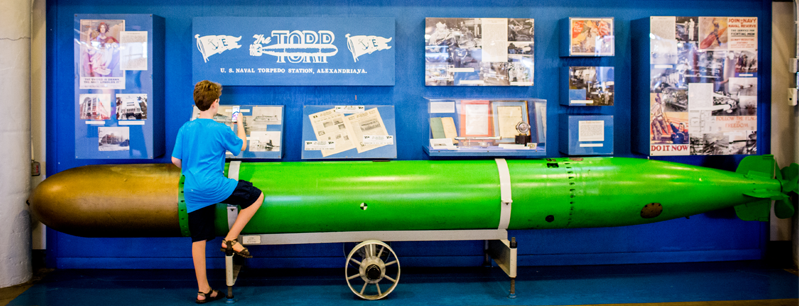
The Mark XIV green torpedo, currently displayed in the main hall, was produced here in 1945. It was painted bright green so that the Navy could find it in the water when it was tested at Piney Point, MD.
After the War ended in 1945, the complex briefly manufactured parts for rocket engines before shuttering permanently in 1946.
By 1950, it was converted to the Federal Records Center in Alexandria. It stored congressional documents, dinosaur bones, German war films and Nuremberg War Crimes trial records.
In 1969, he City of Alexandria purchased three blocks of buildings that had been the Naval Torpedo Station (1919-1946), then the Federal Records Center (1950-1968) from the federal government, including the building now known as the Art Center, for $1.6 million. The U.S. General Services Administration agreed to a five-year deadline to empty all of the contents.
Creation and management of the Art Center:
In 1973, The Art League had a lease at 315 Cameron Street that was expiring. James W. Coldsmith, editor of the Alexandria Journal and chair of the Alexandria Bicentennial Commission, suggested to The Art League’s President Marian Van Landingham, who was also part of the Commission, that they consider the City owned expansive old torpedo plant for a new location. She pitched the idea as a three-year pilot to Mayor Charles Beatley Jr. and it passed City Council on May 7, 1974. City Council approved funding of $140,000 for the first renovation. Work began that spring. City workers used fire hoses to power-wash the building’s interior, which had been neglected since 1969. There were 40 dump trucks of debris.
As the project coalesced, the City hired Van Landingham as director, where she held the position for one year until 1975, when she left to pursue her political career in the Virginia Assembly and remained for 24 years. The City then hired Margaret Alderson in 1975. In 1974 the City charged artists studio rent of approximately $3 per square foot per year, a commitment of low rent that continues today. The City then hired Margaret Alderson in 1975. She remains as the Art Center’s longest-serving director, in the role for 10 years, and oversaw the Art Center’s major renovation in 1982-83.
In May 1983, the Navy Seabees delivered the 3,000-pound, 21-foot-long, green MarkXIV torpedo case as a housewarming present. By the re-opening celebrations on May 21, 1983, there were 225 artists at the Art Center, including a harppsichord maker. The following year, for the 10th anniversary, the Spiral Staircase was unveiled. Shortly thereafter, artist Matthew Harwood founded Target Gallery in 1987 as a way to bring artists in from beyond the Art Center’s walls.
The City of Alexandria managed the Art Center for 22 years until 1996, when it began offering ground leases for the surrounding properties to third-party groups. Torpedo Factory Artists Association managed the Art Center for 12 years, 1998 – 2010. The specially created Torpedo Factory Art Center Board nonprofit managed the Art Center for five years, 2011 – 2016.
The City of Alexandria, through the Office of the Arts, assumed temporary management of Torpedo Factory Art Center in 2016. In Fall 2018, Alexandria City Council affirmed that the City of Alexandria Office of the Arts would continue as the long-term managing entity responsible for management and operations of the Art Center. In December 2021, the Alexandria City Council directed staff to work with stakeholders who recommended a new governance structure that will function as a quasi-public entity.
As in the beginning, rent for artists and arts organizations remands subsidized. It is currently $18.45 per square foot per year, or $1.53 per square foot per month, which is below market rate.
Today, Torpedo Factory Art Center remains the creative engine for the region. In 2024, the Art Center celebrated its 50th anniversary.